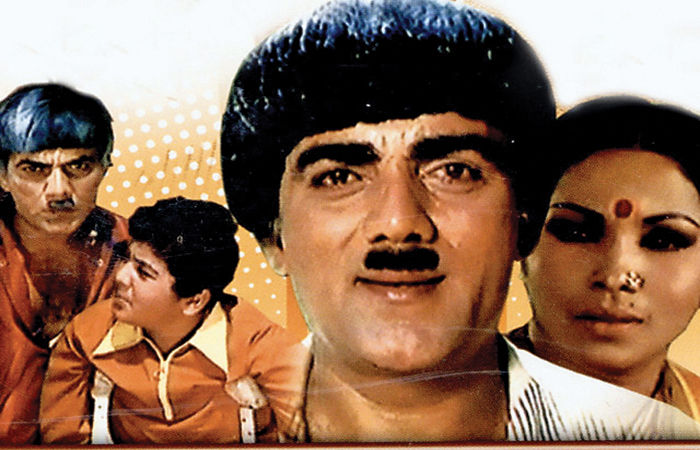
- The young man who had no interest in music as a child later became a musician who was called by Dev Anand, Yash Chopra and other top filmmakers. This same Rajesh Roshan who made megastar Amitabh Bachchan in films for the first time.
- Single father
We have started talking about the music of young composer Rajesh Roshan swimming against the storm of Megastar Amitabh Bachchan's Angry Young Man. According to one version, musician Laxmikant recommended Rajesh to Mehmood. Rajesh worked as an assistant to Laxmikant-Pyarelal for five years. We talked a little bit about the Vyndal song of 'Kunwara Baap'. Apart from fifteen vyandals in this song, Mahmood himself sang one antar. However, it cannot be said that he actually sang in the sense of singing. This song was different from contemporary songs in many ways.
If you listen to the song 'Saj Rahi Gali Meri Maan...' on YouTube again today, you will understand. The swaralgaon, the phrasing of the words, the pitch of the song, the halak, and the average delivery - everything was just like the street-singing vagrants. Even so, the style known today as rap song was an experiment in interlude rhythmic chanting. An entire distance was sung by Mahmood himself. From where the protagonist got this child and under what circumstances he was forced to keep this child, everything has been presented in Mahmudwala Antara. Lyricist Majrooh Sultanpuri composed the words to suit the story. This song created a huge sensation. If you ask the truth, almost all the songs of the movie 'Kunwara Baap' were hits.
Some of the songs had a truly magical touch. Like a movie lullaby. Some of the lullaby songs we have heard earlier are still memorable. Like 'Dheere Se Ankhian Mein Aaja Ri..' (film 'Albela', music by C Ramachandra), 'Aaj Kal Mein Dhal Gaya...' (film 'Beti Bete', music by Shankar-Jaikisan), 'Main Gaon Tum' So Jao...' (Film 'Brahmachari', Sangeet Shankar-Jaikisan) etc. The lullaby given by Rajesh in 'Kunwara Baap' could stand tall with all these lullabies. Its tagline was 'Aa Ri Aaja Nindia, Tu Le Chal Kahin...' The song was sung by Kishore Kumar, Lata Mangeshkar and Mehmood.
Similarly, a beautiful children's song 'Main Hoon Ghoda Yeh Hai Gaadi...' also made a strong impression. This song was sung by Kishore Kumar, Mahmood and friends. It is composed in refreshing raga Pahari and Tal Keharwa. It seems a little surprising when we talk about these things today. Why? If such a question arises, read further. Rajesh was only eleven-twelve years old when musician Roshan died on November 16, 1967 at the age of 49. Motobhai Rakesh was 18 years old and wanted to make a career in acting.
Born to a Punjabi father, Roshan, and a Bengali mother, Irani Kook, Rajesh was neither interested in acting nor in music. Understand that the film was completely detached from nature. Bewildered by Roshan's untimely death, Roshan's wife was a bit confused as to what to do next. When Roshan left, our Garva Gujarati mandolin and sarod player Kishore Desai was Roshan's main assistant. When he had his last heart attack, Roshan told his wife Ira not to worry. Kishore will finish my unfinished work. Kishorebhai did that work but it is true. Kishorebhai also suggested a trick to divert Rajesh to his father's path.
Ira began his musical training under Ustad Faiyaz Ahmad Khan of the Kirana Gharana. For that reason, when Ira went to Khansaheb's house, she would take Rajesh with her after persuasion. After some time, the musical traditions hidden in Rajesh's jeans were awakened. After all, there was a musician's son. He used to hear the music echoing in the house day and night. Peacock eggs have to be cracked? He also started learning music from Khansaheb. Ira, pleased to see that Rajesh was interested in music, sent him to Baba Ramprasad (father of musician Pyarelal). Ramprasadji could play dozens of instruments and was a master of staff notation which is essential for a film composer. He started to dice this rough diamond.
By the way, we are all grateful to Baba Ramprasad. There was a time when Gowanese Christian masters had a monopoly on film music. Most of our musicians did not know staff notation, so they used to bully in this Sarijinda manner. In those days, Baba Ramprasad was the Bandmaster of the British Army. In those days of Songhwari, he used to get a salary of 800 rupees. After listening to the Mumbai film industry, he quit his job as a military band master. He came to Mumbai and caught tabrias wandering in the streets of the slums and trained them to play different instruments using the Gurukul method and read-write the staff notation and play as written. Where at one time 90 percent of Govans were Christian musicians, our local musicians have set up. In this way, Ramprasadji rendered invaluable service to film music.
Laxmikant-Pyarelal took Rajesh, who was ready with Ramprasadji, into their wing. Apart from working as an assistant musician, Rajesh also learned the ins and outs of conducting an orchestra under these two masters. Thus mastered the art of making lines that attract people. Thus, this young man who had no interest in music as a child later became a musician who was called by Dev Anand, Yash Chopra and other top filmmakers. This same Rajesh Roshan who made megastar Amitabh Bachchan in films for the first time. More on that later.
Comments
Post a Comment
Thanx for your precious time